

EPPO Alert List – Erthesina fullo (Hemiptera: Pentatomidae, yellow-spotted stink bug)
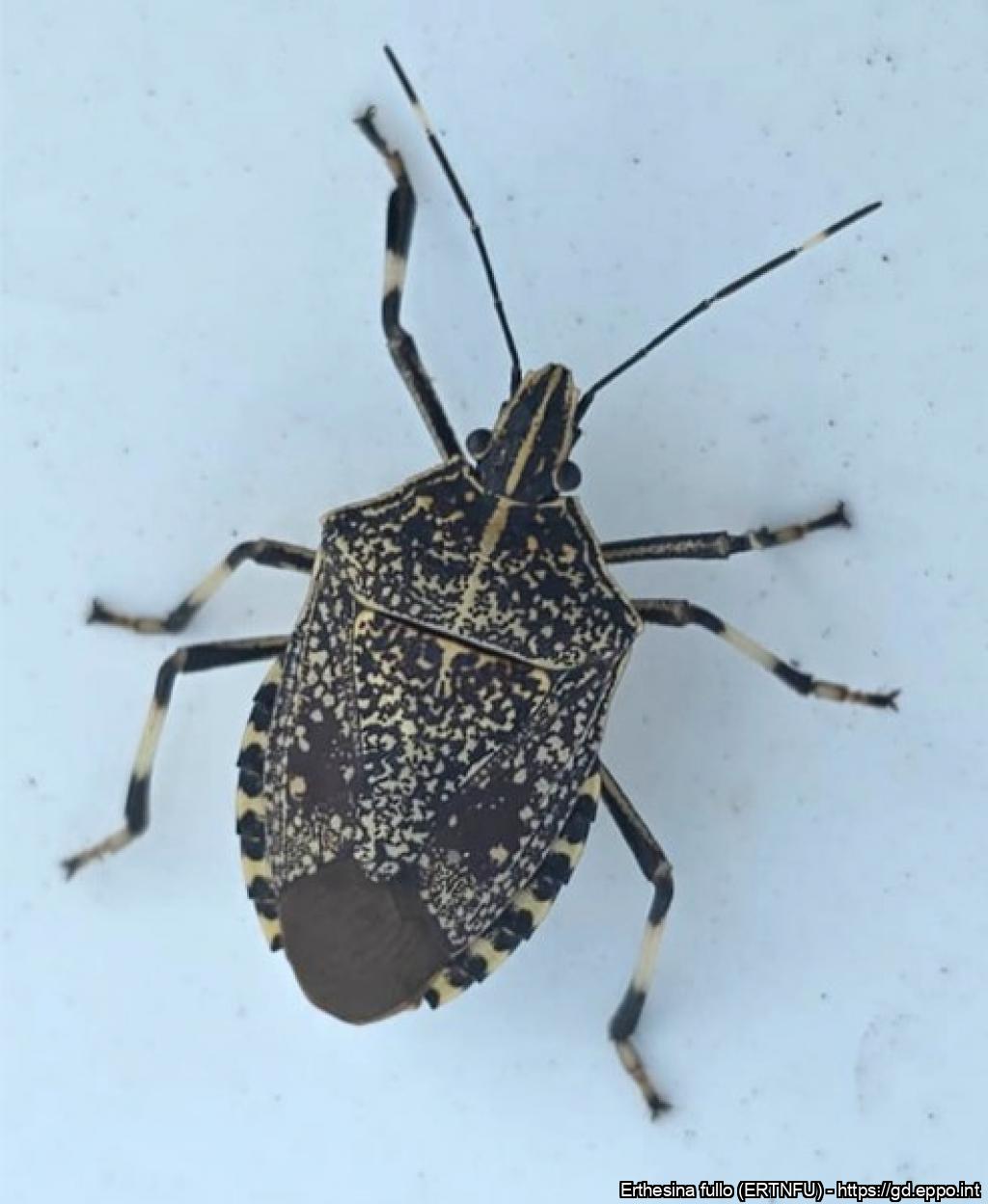
Erthesina fullo, female in Italy (April 2026). Source: https://doi.org/10.1111/epp.70077
Courtesy: Enzo Moretto
Why
Erthesina fullo (Hemiptera: Pentatomidae) is a highly polyphagous pest originating from Asia. It has demonstrated an ability to move over long distances with trade and transport and has recently expanded beyond its native range. In the EPPO region it is established in Albania, and specimens have been recently observed in several countries. Because of its invasive behaviour, broad host range and potential to damage economically important fruit crops, the EPPO Secretariat considered it useful to add this pest to the EPPO Alert List.
Where
Erthesina fullo is native to Asia
EPPO region: Albania (present, restricted distribution)
Isolated specimens were also reported from Belgium (one adult in October 2025); Greece (an adult and a nymph in Peloponnesus in 2024); Italy (one adult in Veneto in 2026). It has also been intercepted in Czechia.
Asia: Bangladesh, China, India, Indonesia, Japan, Myanmar, Nepal, Pakistan, Sri Lanka, Taiwan and Vietnam.
South America: Brazil (São Paulo State).
On which plants
Erthesina fullo is highly polyphagous, feeding on over 60 host plant species across over 30 families. Economically important hosts include kiwifruit (Actinidia spp.), pear (Pyrus spp.), apple (Malus domestica), peach (Prunus persica), apricot (Prunus armeniaca), pomegranate (Punica granatum), Chinese jujube (Ziziphus jujuba), Citrus species and macadamia (Macadamia spp.). It is also recorded on forest, ornamental and wild plants, including Tilia cordata, Robinia pseudoacacia, Populus and Ulmus species.
Damage
Nymphs and adults pierce and suck leaves, flowers, shoots and fruits. Feeding may cause discoloration, wilting or defoliation, dry or corky tissues, fruit deformation and reduced fruit quality; feeding wounds may also cause infections of pathogenic bacteria or fungi, resulting in fruit rot. In the worst cases, feeding can also cause fruit to abort prematurely, leading to significant yield losses. Reported damage in the native range includes losses of 10–30% in kiwifruit orchards, up to 60% damage in pear, and about 20% in apple and macadamia. The magnitude of economic damage in recently invaded areas remains uncertain.
Adults are large stink bugs, approximately 18–23 mm long, usually dark brown to black with numerous yellow or orange spots. Eggs are laid in clusters, generally on the underside of leaves. The species is usually univoltine (one generation per year) in temperate parts of its range. It has five nymphal instars and overwinters as an adult.
Dissemination
Adults are active fliers; experimental observations indicate that they can fly up to approximately 3 km within 5 days. Early-instar nymphs remain close to the eggs on the host plants, whereas later-instar nymphs move around in search of food. Long-distance spread is mainly human-assisted. Eggs and nymphs may be transported on host plants, while adults readily behave as hitchhikers in containers, vehicles, machinery and luggage.
Pathways
Host plants for planting, cut branches and other host plant material, host fruits. As a hitchhiker on containers, used vehicles and machinery, passengers' luggage. The pest has been intercepted or detected in association with traded goods and transport in Korea Republic, New Zealand, the United Kingdom and Czechia, including on imported wood.
Possible risks
Erthesina fullo has a broad host range that includes major fruit crops grown throughout the EPPO region, particularly apple, pear, peach, apricot and kiwifruit. Hosts are abundant in orchards, urban areas and natural habitats. Its establishment in Albania, and the recent incursions in Belgium, Greece and Italy show that it can reach and survive in parts of the EPPO region. Ecological niche models also identify climatically suitable areas outside its native range, including part of the EPPO region (Southern Europe and North Africa). If established, the pest could reduce yield and market quality and increase crop-protection costs. Its hitchhiking behaviour makes exclusion and detection difficult. E. fullo adults aggregate and can overwinter in large numbers in buildings. Uncertainty remains concerning establishment limits, population growth and the level of damage under conditions in the EPPO region. Although its reproductive capacity is lower than Halyomorpha halys, the two sympatric species share many other biological characteristics.
Sources
Baek IS, Jang BJ, Cha MJ, Kim M, Cho Y, An J (2025) Alien hitchhiker insects detected in empty containers entering south korea in 2024. Proceedings of the National Institute of Ecology of the Republic of Korea 6(2), 91-96, https://doi.org/10.22920/PNIE.2025.6.2.91
Claerebout S, Lupoli R, Valdueza M (2025) Premier signalement d'Erthesina fullo (Thunberg, 1783)(Hemiptera: Heteroptera: Pentatomidae) en Belgique. Bulletin De La Societe Royale Belge d'Entomologie 161(2), 148-152.
Lupoli R, van der Heyden T, Dioli P (2020) Erthesina Spinola, 1837 – a new alien genus for Europe found in Albania (Hemiptera: Pentatomidae). Heteroptera Poloniae - Acta Faunistica 14, 121–123. http://doi.org/10.5281/zenodo.3882222
Mi Q, Zhang J, Gould E, Chen J, Sun Z, Zhang F (2020) Biology, ecology, and management of Erthesina fullo (Hemiptera: Pentatomidae): a review. Insects 11(6), 346. https://doi.org/10.3390/insects11060346
Santos RC, Batista CV, Santos AA, da Silva RS, Picanço MC (2023) Predicting suitable areas for the invasive species Erthesina fullo (Hemiptera: Pentatomidae). Crop Protection 172, 106297.
Scaccini D, Moretto E, Dioli P, Pozzebon A (2026) First record of Erthesina fullo (Thunberg, 1783) (Hemiptera: Pentatomidae) in Italy. EPPO Bulletin 56(2), 338-342. https://doi.org/10.1111/epp.70077
Zhu G, Bush TN, Burgstahler KS, Green N, Cook H, Rampone E, Crowder DW (2023) Estimating the potential distribution of yellow spotted stink bug (Erthesina fullo) using ecological niche models. Entomological Science 26(4), e12566. https://doi.org/10.1111/ens.12566
Zografou K, Lupoli R, van der Heyden T, Dioli P (2024) Erthesina fullo (Thunberg, 1783) – first record of this invasive species in Greece (Hemiptera: Pentatomidae). Heteroptera Poloniae – Acta Faunistica 18, 39–41. https://doi.org/10.5281/zenodo.14495261
EPPO RS 2020/170, 2021/133, 2025/001, 2026/141