

EPPO Alert List – Amrasca biguttula (Hemiptera: Cicadellidae, two-spot cotton leafhopper)
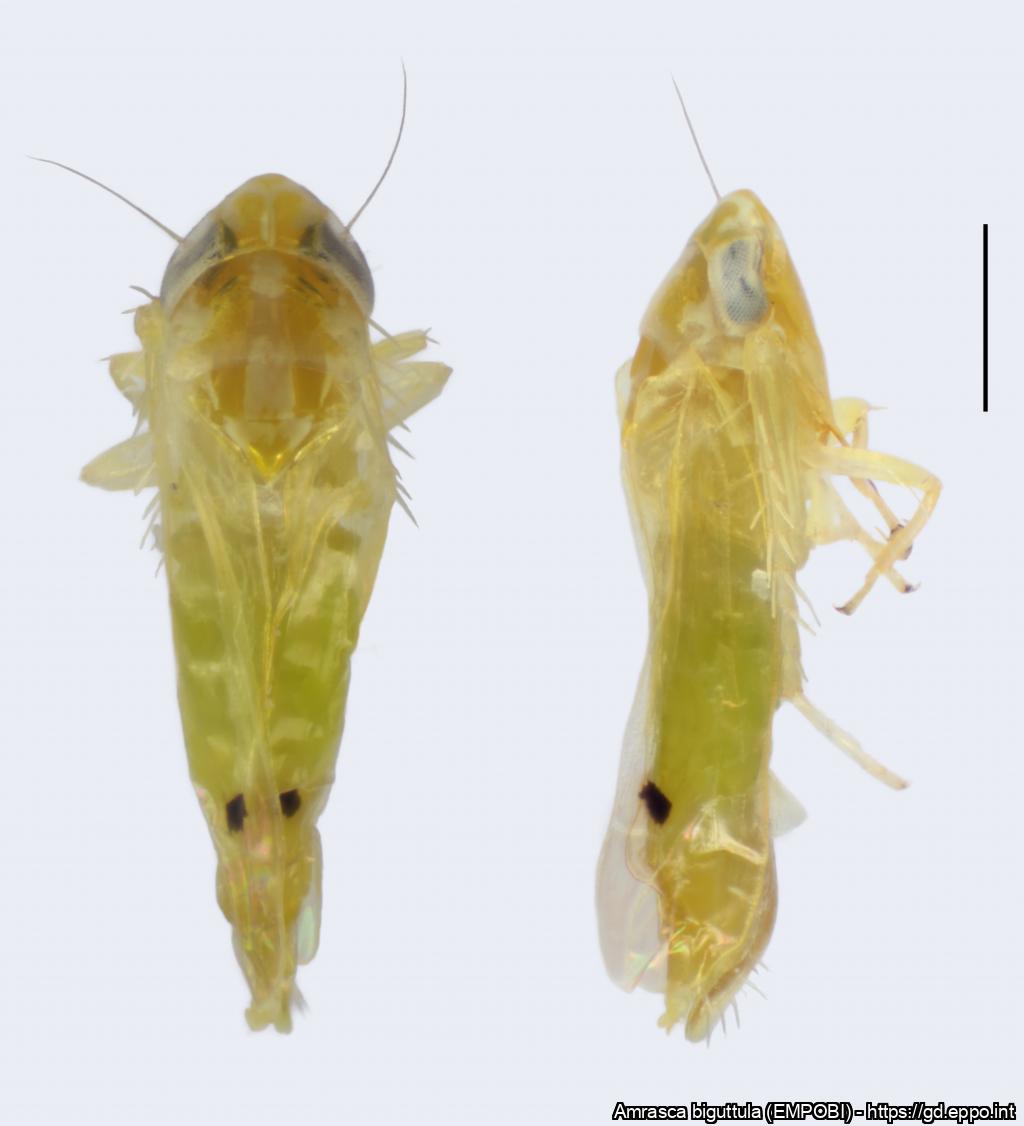
Image of A. biguttula
Courtesy: Mauricio Michel (Agricultural Science and Production Department, Zamorano University, Honduras)
Why
Amrasca biguttula is a polyphagous pest originating from Asia that has recently spread to Africa and the Americas. Because of its invasive behaviour and its potential to cause damage were it to establish, the EPPO Secretariat considered it useful to add this pest to the EPPO Alert List.
Where
A. biguttula originates in Asia. It has largely extended its geographical distribution over the past five years. It was first recorded as a plant pest in western Africa after 2020 and its exact distribution in Africa is uncertain. It was first confirmed as established in North Africa (Egypt) in 2024. It was first recorded in the Caribbean in 2023 (EPPO RS 2024/036), and in Central and North America in 2025 (EPPO RS 2025/233 and EPPO RS 2025/234).
EPPO region: Türkiye
Africa: Benin, Botswana, Burkina Faso, Cameroon, Chad, Cote d'Ivoire, Egypt, Ghana, Mali, Niger, Senegal, Tanzania, Togo
Asia: Afghanistan, Bangladesh, China (Anhui, Hainan, Hebei, Henan, Hubei, Hunan, Jiangsu, Jiangxi, Shaanxi, Shandong, Zhejiang), India (Andhra Pradesh, Assam, Bihar, Chhattisgarh, Delhi, Gujarat, Haryana, Himachal Pradesh, Jammu & Kashmir, Karnataka, Kerala, Madhya Pradesh, Maharashtra, Meghalaya, Odisha, Punjab, Rajasthan, Tamil Nadu, Tripura, Uttarakhand, Uttar Pradesh, West Bengal), Indonesia (Java, Nusa Tenggara), Iran, Iraq, Japan (Honshu, Kyushu, Ryukyu Archipelago, Shikoku), Pakistan, Philippines, Sri Lanka, Taiwan, Thailand, Türkiye, Vietnam
North America: United States of America (Alabama, Florida, Georgia,Louisiana, Mississippi, North Carolina, South Carolina, Tennessee, Texas)
Central America and Caribbean: Anguilla, Antigua and Barbuda, Barbados, Honduras, Martinique, Puerto Rico, Saint Kitts and Nevis, Virgin Islands (US)
Oceania: Micronesia
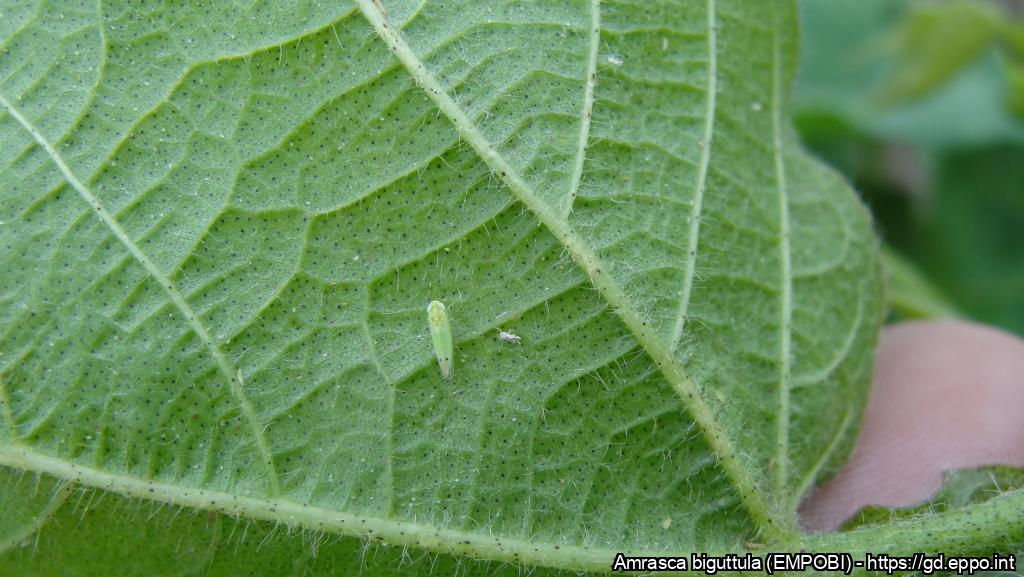
Image of an adult A. biguttula
Courtesy: Baswaraj Bhede
On which plants
Amrasca biguttula is a serious pest of cotton (Gossypium spp.), aubergine (Solanum melongena) okra (Abelmoschus esculentus), roselle (Hibiscus sabdariffa), sunflower (Helianthus annuus) in its original and invasive range. It is also recorded to feed on a variety of other crops such as potato, tomato, peanut, as well as on weeds.
Damage
Damage is caused by the nymphs and adults feeding on the lower surface of leaves, sucking the contents of the cells. This causes yellowing, reddening, then browning of leaves, characteristic of a syndrome called ‘hopperburn’ along with wilting and curling of the leaves and stunting of the plant. Yield loss can be very high, with more than 50% loss on cotton.
A. biguttula is a small light green leafhopper with adults ranging from 2.5–3.0 mm in length. Identification is difficult and requires dissection and examination of the male genitalia. The species may be confused with other species of leafhoppers, e.g. in the genera Amrasca, Empoasca, Jacobiasca.
Eggs are laid in the leaf lamina or in the fruit rind. There are five nymphal instars. Numerous generations may occur in a year when temperatures are suitable.
Control is difficult and is based on a combination of the use of insecticides and resistant varieties. No natural enemies are known.
Dissemination
Leafhoppers are very mobile, as the adults hop away when disturbed. However, there is no data on the natural spread on A. biguttula. In international trade, the pest may be transported as eggs on plants for planting.
Pathways
host plants for planting, host fruits?
Possible risks
A. biguttula has recently been recorded in many new countries, and could therefore be introduced to EPPO countries. Climate in most of the EPPO region is not optimal for the development of A. biguttula as it is considered to thrive when temperatures are between 18 and 35°C but recent modelling showed that it could establish in areas of the EPPO region where cotton is grown and it has recently established in Egypt. Considering its extensive host range, it could also cause damage other crops of economic importance.
Sources
Ahmed MZ, Yadav N, Rustgi S, Saripalli G, Esquivel IL, Bryant TB, Graham S, Jacobson AL, Gireesh M, Joseph SV, Del Pozo‐Valdivia A (2026) Global phylogeography of Amrasca biguttula (Hemiptera: Cicadellidae) across eight countries reveals a single‐haplotype incursion into the United States beyond its putative native range. Journal of Applied Entomology (early view).
Attia S, Joseph SV (2026) Incidence of the Two-Spotted Cotton Leafhopper (Hemiptera: Cicadellidae) infesting Hibiscus syriacus in ornamentals. Agronomy 16(1), 32. https://doi.org/10.3390/agronomy16010032
Azrag AA, Niassy S, Bloukounon‐Goubalan AY, Abdel‐Rahman EM, Tonnang HE, Mohamed SA (2025) Cotton production areas are at high risk of invasion by Amrasca biguttula (Ishida)(Cicadellidae: Hemiptera): potential distribution under climate change. Pest Management Science 81(6), 2910-2921.
Bozdoğan İE, Carpar H, Demirel N, Coşkun ÖF (2026) First record of Amrasca (Sundapteryx) biguttula (Ishida, 1913)(Hemiptera: Cicadellidae: Typhlocybinae) from Türkiye and its morphological and molecular identification. Zootaxa 5768(2), 261-272.
CABI datasheet on Amrasca biguttula (Indian cotton jassid). https://doi.org/10.1079/cabicompendium.20857
Collins-Smith S (2025-09-23) Invasive pest confirmed in Mississippi cotton. https://extension.msstate.edu/news/feature-story/2025/invasive-pest-confirmed-mississippi-cotton
Dawson K, Villagas J (2025-10-08) Cotton Jassids detected in Tensas parish cotton fields https://www.lsuagcenter.com/articles/page1759931145787
El-Hady RM, El-Hashash AE (2025) A taxonomic study of Amrasca biguttula (Ishida, 1913) (Cicadellidae, Typhlocybinae) in Egypt. Acta Entomology and Zoology 6(1), 25-29. https://doi.org/10.33545/27080013.2025.v6.i1a.186
Esquivel I, Bryant T, Malone S, Jacobson AL, Graham SH, Gimenez-Cremonez PS, Roberts P, Paula-Moreas S, Reisig D, Huseth A, Greene J (2025) First report of two-spot cotton leafhopper (Amrasca biguttula Ishida)(Hemiptera: Cicadellidae) on commercial cotton in the southeastern United States. Insects 16(9), 966. https://doi.org/10.3390/insects16090966
Kamble CS, Sathe TV (2015) Incidence and host plants for Amrasca biguttula (Ishida) from Kolhapur region, India. International Journal of Development Research 5(3), 3658-3661.
Liburd O E, Halbert S E, Samuel N, Dreves AJ (2024) Two-spot cotton leafhopper, Hemiptera: Cicadellidae, Typhlocybinae, Empoascini; Amrasca biguttula (Ishida) – A serious pest of cotton, okra and eggplant that has become established in the Caribbean Basin. Pest Alert No. FDACS-P-02229. Florida Department of Agriculture and Consumer Services Division of Plant Industry. Available at https://ccmedia.fdacs.gov/content/download/117692/file/two-spot-cotton-leaf-hopper-pest-alert.pdf
Michel M, Orozco J (2025) First record of an Asian leafhopper, Amrasca biguttula (Ishida) (Hemiptera: Cicadellidae), in Central America. Insecta Mundi 1147, 1–8.
Reising D, Collins G (2025-09) Invasive cotton jassid arrives in North Carolina cotton. https://cotton.ces.ncsu.edu/2025/09/invasive-cotton-jassid-arrives-in-north-carolina-cotton/
Saeed R, Razaq M, Hardy IC (2015) The importance of alternative host plants as reservoirs of the cotton leaf hopper, Amrasca devastans, and its natural enemies. Journal of Pest Science 88, 517–531.
Sawadogo WM, Nabié B, Sanou MR, Kouanda N, Sawadogo AW, Kabore H, Boly/Sereme B, Sonda D (2023) Une espèce émergente de jasside fait des ravages sur le cotonnier, gombo, l’aubergine et la rosselle (Bissap) au Burkina Faso. 2 p. https://www.cnabio.net/app/download/14548020678/202303_Alerte_A_+biguttula_nuisibles+
Villagas J, Dawson K (2025-09-15) Cotton jassid detected in Louisiana: monitoring intensifies as pest spreads across the southeast. https://www.lsuagcenter.com/articles/page1757979892313
Vyavhare S, Kerns D, Santiago-Gonzalez J, Porter P (2025-09) Update on the cotton jassid: a new pest of concern in Texas cotton. ENTO-PU-247. Texas Agrilife Extensio. https://agrilifeextension.tamu.edu/wp-content/uploads/2025/09/ENTO-PU-247-Update-on-Cotton-Jassid.pdf
Xu YE, Wang Y, Dietrich CH, Fletcher MJ, Qin D (2017) Review of Chinese species of the leafhopper genus Amrasca Ghauri (Hemiptera, Cicadellidae, Typhlocybinae), with description of a new species, species checklist and notes on the identity of the Indian cotton leafhopper. Zootaxa 4353(2), 360-370.
EPPO RS 2025/235, RS 2026/032, RS 2026/117
Entry date 2025-10