

EPPO Alert List – Vascular streak dieback
An emerging disease of ornamentals
Why
A sample of redbud (Cercis canadensis) that showed wilting and dieback was received by the Tennessee Department of Agriculture in 2019 and since then, multiple laboratories in Southern USA have received numerous plant samples with symptoms of vascular streak dieback similar to those caused by Ceratobasidium theobromae on cocoa. Although the identity of causal agent of this vascular streak dieback in the USA is not yet clear, this disease is increasing its geographical and host ranges. As the host range includes popular ornamentals, the EPPO Secretariat considered it useful to add this disease to the EPPO Alert List.
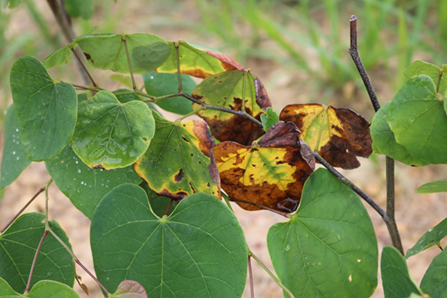
Leaf scorch and interveinal chlorosis associated
with VSD symptomatic Cercis canadensis seedlings
Courtesy: Dr Fulya Baysal-Gurel, Tennessee State University (US)
Where
Vascular streak dieback is causing damage in Virginia, North Carolina and Tennessee. In 2024, individual cases also occurred in nurseries in Indiana, Florida and Oklahoma, and in 2025 in Alabama, Maryland, Oregon, Missouri, Pennsylvania, South Carolina.
EPPO region: Absent.
North America: USA (Alabama, Florida, Indiana, Maryland, Missouri, North Carolina, Oklahoma, Oregon, Pennsylvania, South Carolina, Tennessee, Virginia).
On which plants
Vascular streak dieback symptoms were first recorded on redbud (Cercis canadensis) but since then over 46 ornamental and woody plant genera have been recorded as host, including more than one species of Acer, Carpinus, Catalpa, Cornus, Magnolia, Prunus, Quercus, and Viburnum.
Damage
In recent years, nurseries in Virginia, North Carolina and Tennessee have observed wilt and severe dieback on C. canadensis (redbud), Acer spp. (maple) and Cornus spp. (dogwood) plants. In some cases, 90-100% of nursery stock was unsellable due to the severity of damage. Vascular streak dieback was observed in nurseries, as well as in newly planted landscape plants and natural landscapes.
Early symptoms include leaf chlorosis, scorched leaf margins, and stunting and/or wilting of the current year’s growth, eventually leading to death of individual branchesThis dieback may continue into the main stem of the tree and ultimately cause tree death. Streaking or discoloration within the vascular tissue can be observed when symptomatic branches or stems are cut. Opportunistic fungi such as Botryosphaeria and Phomopsis colonize the weakened branches and cause cankers. There are currently no recommended chemical or cultural treatments available. Infested plants should be removed and incinerated to prevent any further spread.
The causal agent of vascular streak dieback in the USA is considered to be a Ceratobasidium species close to C. theobromae, is a damaging pathogen on cocoa (Theobroma cacao) and cassava (Manihot esculenta) in South-East Asia and Melanesia. Ceratobasidium species are difficult to maintain in culture, making it impossible so far to complete Koch’s postulates. PCR and real-time PCR tests have been developed for reliable diagnostic of vascular streak dieback in the USA.
Pictures of symptoms observed can be viewed on the Internet: https://www.pubs.ext.vt.edu/content/pubs_ext_vt_edu/en/SPES/spes-483/spes-483.html
Dissemination
The spread of the disease is suspected to be via wind-dispersed spores, that are not disseminated over long distances. Pruning and grafting tools may transmit the pathogen from infested plants to healthy plants. Trade of plants for planting could be a pathway for long distance spread.
Pathways
Plants for planting, cut branches?
Possible risks
Host plants of vascular streak dieback include woody ornamentals that are frequently traded and grown in the EPPO region. The disease causes dieback and mortality of plants and could have an important impact in nurseries if it was introduced into the EPPO region.
Sources
Baysal-Gurel F, Liyanapathiranage P (2024) Vascular Streak Dieback, an emerging threat to the redbud nursery production in the southeastern United States. Tennessee State University. ANR-PATH-1-2024. https://www.tnstate.edu/extension/VSD%20FAct%20Sheet%20TSU_PL_Feb%2026.pdf
Beckerman J, Creswell T, Bonkowski J, Baysal-Gurel F (2022) Vascular streak dieback of redbud: what plant pathologists know so far. https://www.hriresearch.org/vascular-streak-dieback-update
Belay KH, Abdelrazek S, Kaur S, Mazloom R, Bily D, Gyatso T, Avin FA, Bonkowski J, Liyanapathiranage P, Rodriguez Salamanca L, Heath LS (2026) Genomic insights into Ceratobasidium sp. associated with vascular streak dieback of woody ornamentals in the United States using a metagenomic sequencing approach. Microbiology Spectrum e02523-25. https://doi.org/10.1128/spectrum.02523-25
Bily D, Gyatso T, Avin FA, Bonkowski J, Liyanapathiranage P, Rodriguez Salamanca L, Vinatzer B, Baysal-Gurel F (2026) A Ceratobasidium sp. D.P. Rogers associated with vascular streak dieback of woody ornamental plants in Virginia, U.S.A. Plant Disease (early view) https://doi.org/10.1094/PDIS-02-25-0375-RE
Bily D, Rodriguez Salamanca L, Bush E (2023) Vascular Streak Dieback: an emerging problem on woody ornamentals in the U.S. VCE Publications. SPES-483P (SPES-587P). https://www.pubs.ext.vt.edu/content/pubs_ext_vt_edu/en/SPES/spes-483/spes-483.html
Gray J (2024) Unveiling Vascular Streak Dieback: Insights, Surveys, and Solutions. tHRIve - web series. https://www.hriresearch.org/unveiling-vascular-streak-dieback-insights-surveys-and-solutions
Liyanage KH, Liyanapathiranage P, Baysal-Gurel F (2025) Investigating the economic impact of emerging vascular streak dieback threat to redbuds in the us nursery industry. HortScience 60(7), 1244-1250. DOI: 10.21273/HORTSCI18589-25
Liyanapathiranage P, Avin FA, Bonkowski J, Beckerman JL, Munster M, Hadziabdic D, Trigiano RN, Baysal-Gurel F (2025) Vascular streak dieback: A novel threat to redbud and other woody ornamental production in the United States. Plant Disease 109(5), 953-970
Samuels GJ, Ismaiel A, Rosmana A, Junaid M, Guest D, Mcmahon P, Keane P, Purwantara A, Lambert S, Rodriguez-Carres M, Cubeta MA (2012) Vascular streak dieback of cacao in Southeast Asia and Melanesia: in planta detection of the pathogen and a new taxonomy. Fungal Biology 116(1), 11-23.
EPPO RS 2024/110, RS 2026/014